3D Printers
SLS 3D Printers
Peripherals
Printers ecosystem
Customer Zone
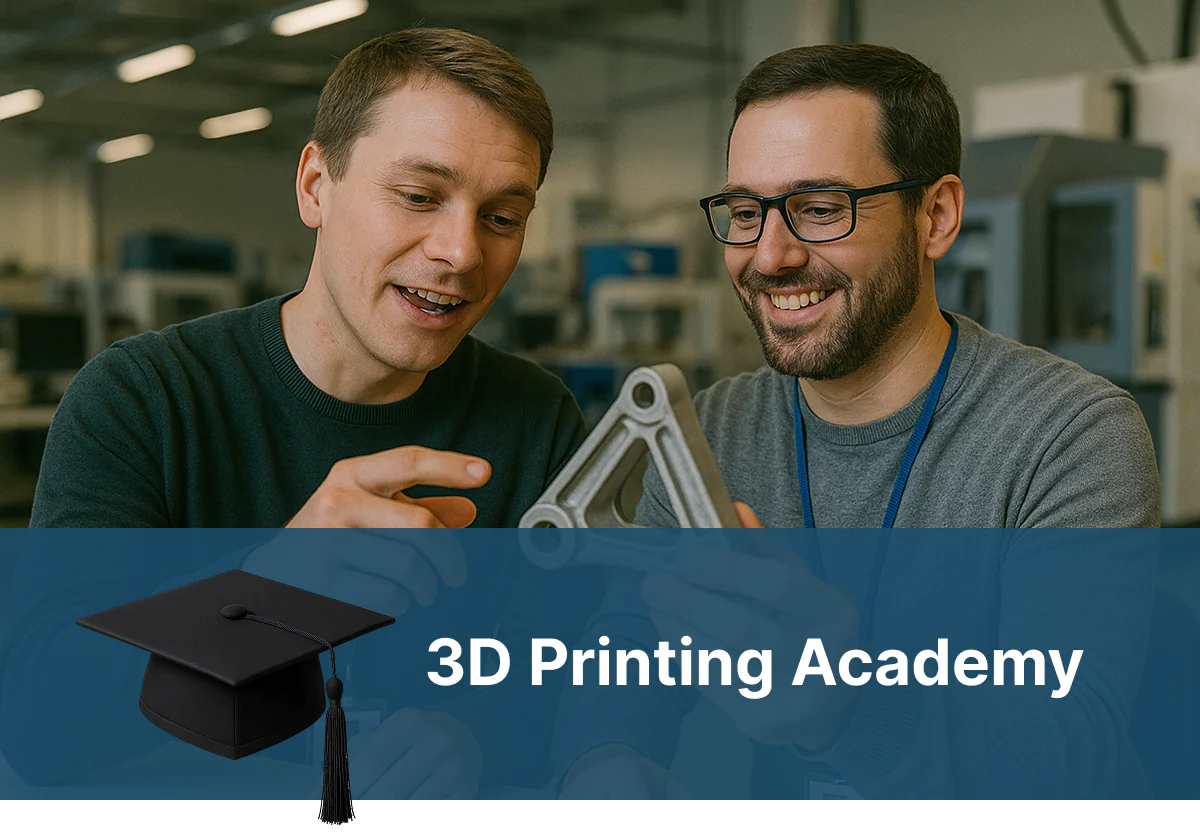
Whether you’re starting your journey with 3D printing or evaluating SLS for professional use, the Academy equips you with:
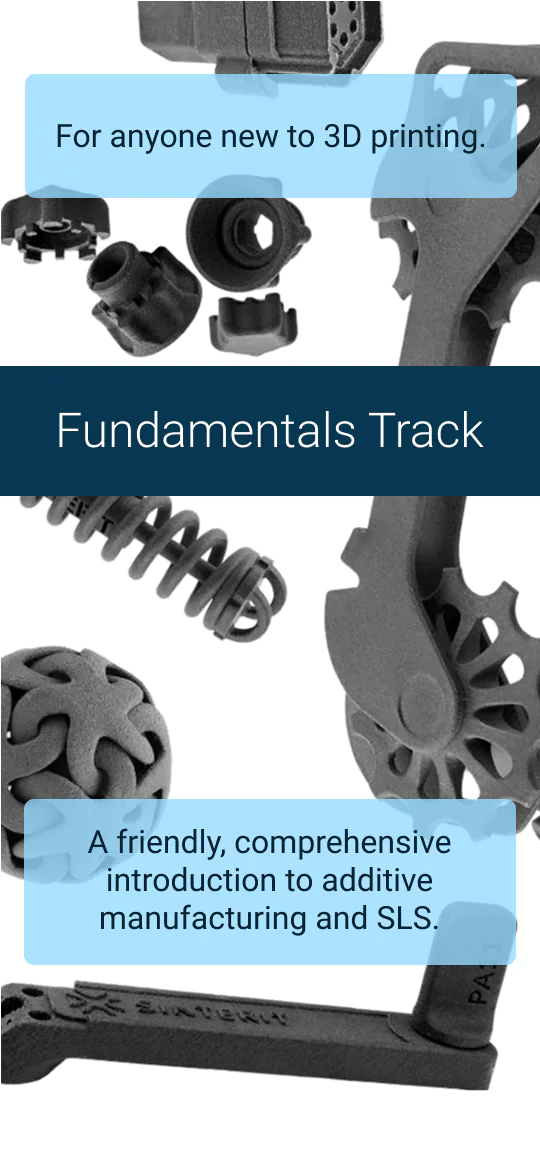
You choose one of three educational tracks: Fundamentals Track, Business Track or Engineers Track.
For 10 days, you receive structured, high-quality educational content straight to your inbox:
e-books, videos, infographics, podcasts, calculators, case studies, practical guides, etc.
As an additional benefit, you gain access to a closed LinkedIn expert community—an exclusive space for knowledge exchange, discussions, and networking.
At the end of your track you’ll receive your Certificate of Completion, along with an invitation to a live Q&A session where you can get answers to your questions and see what other Academy participants are asking.
1. What is 3D Printing and How Is It Transforming Production?
History, core concepts, and the impact of additive manufacturing on industries worldwide.
2. Compare the Core Technologies: FDM, SLA, SLS
Simple overview of how each technology works, what they’re best for, and how to choose the right one.
3. How SLS Works: The Magic of Powder and Laser
An intuitive explanation of the SLS printing process, step by step.
4. SLS Materials: Powders and Their Key Properties
Types of powders, mechanical characteristics, and how they influence final parts.
5. From Idea to Printed Part
A practical walk-through of the entire workflow: preparation, printing, post-processing.
6. Most Common Mistakes and How to Avoid Them
Troubleshooting for beginners to help you get reliable results from day one.
7. SLS vs Other Technologies
When SLS surpasses FDM and SLA in quality, durability, or cost efficiency.
8. Real-World Use Cases of SLS
Examples from industry, education, medicine, automotive, and more.
9. The Sinterit Ecosystem
How Sinterit printers, powders, software, and accessories work together as a complete solution.
10. Your First Steps in the SLS World
Summary and guidance on next steps—including which track to take next.
1. Overview of 3D Printing Technologies
Strengths, weaknesses, applications—and an honest, transparent comparison that builds trust.
2. Why SLS? Strategic and Economic Advantages
How SLS shortens time-to-market, supports innovation, and lowers product development costs.
3. Calculating ROI in Additive Manufacturing
A practical framework for evaluating return on investment in 3D printing.
4. In-House Printing vs Outsourcing
Cost, logistics, maintenance, scalability—when each makes sense.
5. Success Stories: From Prototype to Production
Concrete case studies showing measurable improvements in cost, flexibility, and delivery times.
6. Building Internal Competencies
How to structure teams, workflows, and processes around additive manufacturing.
7. How to Choose the Right SLS System
Key criteria to evaluate printers, materials, service, and technical support.
8. Funding and Financial Support
Practical guidance on securing financing for SLS investments.
9. Trends in 3D Printing
What’s next: new materials, automation, sustainability, and AI in AM.
10. Your Implementation Roadmap
A step-by-step plan to start your company’s SLS transformation.
1. Understanding SLS: From Physics to Practice
A complete explanation of the SLS process and its fundamental parameters.
2. Designing for Additive Manufacturing
How to create models optimized for powder-based printing.
3. Orientation and Packing Strategies
Maximizing chamber efficiency while improving part quality.
4. Printing Parameters and Their Impact
Temperature, laser power, scanning speed—practical guidance for optimization.
5. Powder Management
Recycling, quality control, and maintaining material consistency.
6. Post-Processing Techniques
Cleaning, finishing, coloring, and mechanical treatments.
7. Diagnostics and Maintenance
Identifying typical issues and ensuring long-term process stability.
8. Special Materials
Flexible, ESD, reinforced powders—selection and application.
9. Mechanical Properties and Quality Testing
How to measure and analyze the physical performance of printed parts.
10. Future of SLS
Automation, predictive algorithms, process simulation, sustainability.
Need a 3D Printer tailored for this purpose?

Your concerns may include costs, ROI, customer support, print quality, or printing speed. We have helped thousands of companies make the right choice.
 Austria
  Bosnia and Herzegovina
  Bulgaria
  Croatia
  Czech Republic
  Denmark
  Estonia
  Finland
  France
  Germany
  Greece
  Hungary
  Ireland
  Italy
Italy  Latvia
  Lithuania
  Poland
  Portugal
  Romania
  Slovakia
  Slovenia
  Spain
Spain  Sweden
  Switzerland
  United Kingdom
  Ukraine
  China
China  Hong Kong
  India
India  Israel
  Japan
Japan  Malaysia
  Philippines
  Saudi Arabia
  South Korea
  Taiwan
  Thailand
  Turkey
  United Arab Emirates
  Egypt
Egypt  South Africa
  Tunisia
  Canada
  Mexico
  United States
  Brasil
  Colombia
  Australia
  New Zealand