Austria
  Bosnia and Herzegovina
  Bulgaria
  Croatia
  Czech Republic
  Denmark
  Estonia
  Finland
  France
  Germany
  Greece
  Hungary
  Ireland
  Italy
Italy  Latvia
  Lithuania
  Poland
  Portugal
  Romania
  Slovakia
  Slovenia
  Spain
Spain  Sweden
  Switzerland
  United Kingdom
  Ukraine
  China
China  Hong Kong
  India
India  Israel
  Japan
Japan  Malaysia
  Philippines
  Saudi Arabia
  South Korea
  Taiwan
  Thailand
  Turkey
  United Arab Emirates
  Egypt
Egypt  South Africa
  Tunisia
  Canada
  Mexico
  United States
  Brasil
  Colombia
  Australia
  New Zealand
 What material does a 3D printer use?
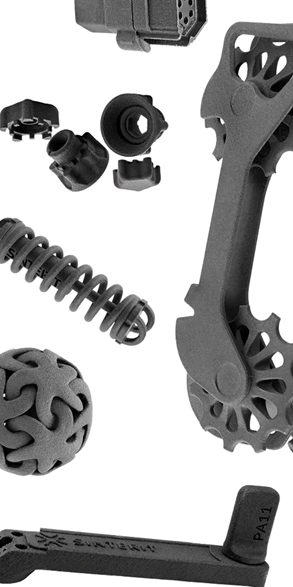
Choosing the right material is one of the most important decisions in any 3D printing workflow. While printer type and model dictate how an object is made, it’s the material that determines how well it performs. From simple PLA filaments to advanced powder-based nylons, the spectrum of 3D printer material types is broader than ever — each with distinct mechanical, thermal, and visual characteristics. Among all additive manufacturing methods, Selective Laser Sintering (SLS) is known for combining industrial-grade performance with material versatility, especially for functional polymers like PA12 or TPU.
In this section, we’ll walk through the key categories of 3D printing materials, their core properties, and how they’re matched to different technologies and applications.
Material types by technology
The material a 3D printer uses depends largely on its printing technology. Each category has specific material formats — filament, resin, powder, or liquid — and comes with its own performance envelope.
Filament-based (FDM/FFF) materials
FDM printers typically use thermoplastic filaments. These are affordable, widely available, and come in a variety of grades and finishes. PLA (polylactic acid) is often used for general prototyping because it’s easy to print and biodegradable. For more robust applications, ABS, PETG, ASA, and polycarbonate offer better thermal and mechanical strength. Some high-performance filaments — like PEEK or PEI — require industrial-grade machines due to their high processing temperatures.
Resin-based (SLA/DLP) materials
SLA and DLP printers use photosensitive resins, which cure under UV light. These materials offer high detail and smooth surface finishes, making them ideal for dental, jewelry, and visual prototyping. However, they tend to be more brittle than thermoplastics. Engineering resins now offer improved durability, flexibility, or heat resistance — but they still require post-curing and are generally not as tough as their FDM or SLS counterparts.
Powder-based (SLS/DMLS) materials
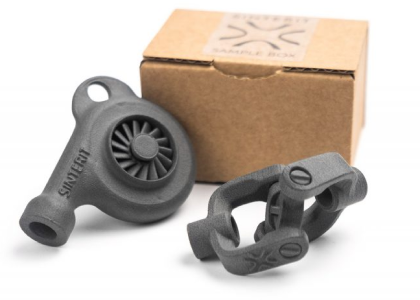
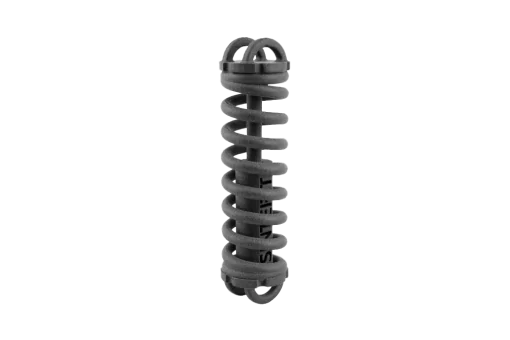
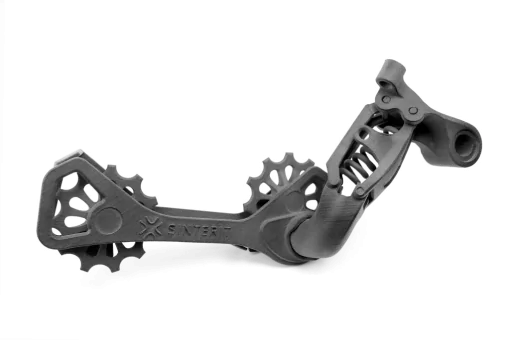
SLS (Selective Laser Sintering) printers use powdered thermoplastics such as PA12, PA11, or TPU — materials that provide excellent mechanical strength, isotropy, and design freedom. They’re often used for functional parts, enclosures, and low-volume production. DMLS and SLM technologies use metal powders — like aluminum, stainless steel, or titanium — to print high-performance metal parts layer by layer. These are suited for aerospace, automotive, and medical applications.
Comparing 3D printer material properties
Each material family brings trade-offs in terms of strength, durability, temperature tolerance, and printability. Here’s a simplified comparison of commonly used types.
| Material | Strength | Flexibility | Temperature resistance | Surface finish | Common use cases |
|---|---|---|---|---|---|
| PLA | Moderate | Low | Low | Smooth | Prototypes, education |
| PETG | High | Moderate | Moderate | Glossy | Mechanical parts, enclosures |
| ABS | High | Moderate | High | Matte | Functional parts, automotive |
| TPU | Low | Very high | Low | Slightly rough | Flexible joints, wearables |
| PA12 | Very high | Moderate | High | Matte | Functional prototypes, end-use parts, tooling |
| Resin | Moderate | Low | Low to medium | Very smooth | Dental, miniature, design models |
| Titanium | Very high | Low | Very high | Metallic | Aerospace, implants, heat exchangers |
How to choose the right 3D printing material
When selecting a material, it’s not just about price or availability. You should consider:
- mechanical demands: does the part need to withstand stress, flex, or impact?
- environmental conditions: will it be exposed to heat, uv, or moisture?
- aesthetic requirements: is surface finish or color matching important?
- post-processing options: can it be painted, coated, or polished effectively?
- regulatory standards: does it need to be biocompatible or food-safe?
Some materials, like PLA, are easy to use but not durable. Others, like PA12 or PEEK, offer exceptional strength but require advanced equipment. Always align material choice with the performance needs of your application — and remember that what works for a prototype may not suit a production part. For parts that require both precision and durability, SLS nylon materials such as PA12 are often the most balanced choice between performance and printability.
Conclusion
3D printing supports a wider range of materials than ever before, from basic plastics to high-performance polymers and metals. Understanding 3D printer material properties and matching them to your goals is key to unlocking the full potential of additive manufacturing. Whether you’re comparing options for a single part or building a full 3D printer materials guide, the right choice can make all the difference in print quality, reliability, and long-term value.
FAQ: 3D printer materials
PLA (Polylactic Acid) is the most widely used material in desktop 3D printing due to its ease of use, low cost, and biodegradable nature. It’s ideal for prototyping and educational applications, though less suited for engineering parts.
Materials like PA12 (nylon), carbon fiber-filled filaments, PEEK, and PEI are known for their high strength, heat resistance, and chemical durability. These are often used in functional prototypes or production parts in industrial settings.
Yes, metal 3D printing technologies like DMLS (Direct Metal Laser Sintering) and SLM (Selective Laser Melting) use powdered metals such as titanium, stainless steel, and aluminum to produce high-performance, complex parts.
PLA is easier to print and more eco-friendly, while ABS offers better mechanical strength and heat resistance. However, ABS requires a heated bed and emits fumes, making it more suitable for enclosed, ventilated setups.
SLS typically uses powdered thermoplastics like PA12, PA11, or TPU, valued for their strength, flexibility, and heat resistance. These materials allow support-free printing and consistent mechanical properties in all directions.
Standard resins used in SLA/DLP printing are more brittle than thermoplastics, but engineering resins can provide better toughness, flexibility, or heat resistance. Still, they generally don’t match the impact resistance of materials like nylon or ABS.
Yes, many filament brands offer rPETG, rPLA, or other recycled blends. Powder technologies like SLS also allow partial reuse of unsintered material from previous prints, supporting more circular workflows.
No. Materials are technology-specific. FDM uses filaments, SLA uses liquid resins, and SLS uses powder. Each format has unique performance traits and application suitability.
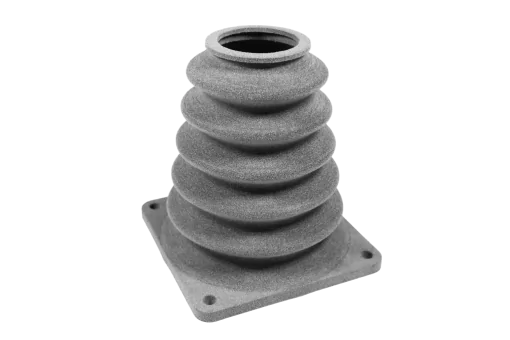
TPU (Thermoplastic Polyurethane) is the most popular flexible filament. It offers rubber-like elasticity and is used for footwear, gaskets, or protective cases. In SLS, flexible nylons and elastomers like PA11 variants offer similar properties.
Start by defining your part’s functional requirements: mechanical load, temperature range, flexibility, and environmental exposure. Then match those needs to compatible materials within your printer’s technology class.
Explore also
- Polymers in 3D printing
- 3D printing of metals
- Biocompatible materials for 3D printing
- Raw materials for 3D printing
- Composites 3D printing
- Recycled 3D printing filament
- 3D printing flexible
- Filament types for 3D printing
- 3D printing strongest material
- 3D printing shape memory polymer
- SLS ceramic
- SLS glass
- SLS wood
- Materials for SLS: guide
Related categories