Austria
  Bosnia and Herzegovina
  Bulgaria
  Croatia
  Czech Republic
  Denmark
  Estonia
  Finland
  France
  Germany
  Greece
  Hungary
  Ireland
  Italy
Italy  Latvia
  Lithuania
  Poland
  Portugal
  Romania
  Slovakia
  Slovenia
  Spain
Spain  Sweden
  Switzerland
  United Kingdom
  Ukraine
  China
China  Hong Kong
  India
India  Israel
  Japan
Japan  Malaysia
  Philippines
  Saudi Arabia
  South Korea
  Taiwan
  Thailand
  Turkey
  United Arab Emirates
  Egypt
Egypt  South Africa
  Tunisia
  Canada
  Mexico
  United States
  Brasil
  Colombia
  Australia
  New Zealand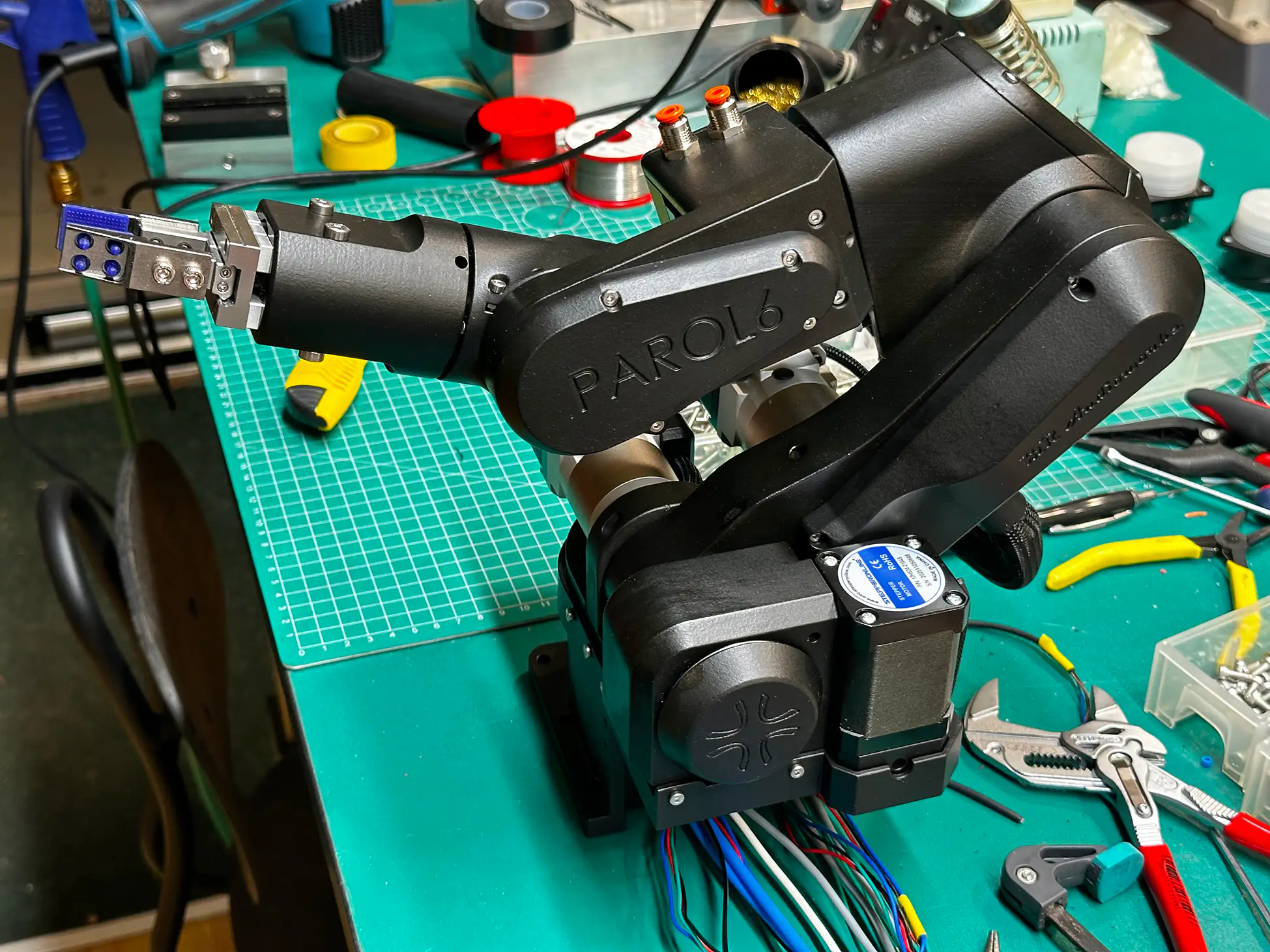
From Open-Source Design to a Functional Robotic Arm: How Indulite Uses SLS to Turn Engineering Ideas into Reality
Sinterit Lisa X and PA12 Industrial enabled Indulite to redesign and manufacture complex robotic components in-house – while vapor smoothing transformed printed parts into professional, functional components.
- Company: Indulite B.V.
- Industry: LED lighting fixtures & custom LED solutions
- Location: Beneden-Leeuwen, The Netherlands
- Website: indulite.nl
- Application: PAROL6 collaborative robotic arm
- Technology: SLS 3D Printing
- 3D Printer: Sinterit Lisa X
- Material: PA12 Industrial
- Post-processing: Sinterit Multi PHS, AMT PostPro DPX, AMT PostPro SFX Vapor Smoothing

All quotations included in this case study come from an interview with Mark Riemersma, Designer / Engineer / R&D at Indulite, conducted in the context of implementing Sinterit’s in-house SLS manufacturing solution.
If you have been following Indulite’s additive manufacturing journey, you may already be familiar with our previous case study showing how the company transformed the production of its custom LED lighting solutions. By implementing a complete Sinterit solution and building an in-house SLS workflow around two 3D printers – Lisa X and SUZY – supported by dedicated post-processing and finishing equipment, including vapor smoothing, Indulite reduced its production lead time from approximately 35 days to just 2 days.
But bringing SLS in-house did more than optimize an existing production process. It gave Indulite a powerful engineering tool for turning entirely new ideas into functional solutions. And the PAROL6 robotic arm is a perfect example of what becomes possible when design freedom, in-house manufacturing and engineering curiosity come together.
Engineering Beyond the Core Business
Indulite B.V. is a Dutch manufacturer of LED lighting fixtures and custom LED solutions. But behind its lighting products is a broader engineering culture built around experimentation, customization and in-house manufacturing.
In a previous Sinterit case study, Mark Riemersma, Designer / Engineer / R&D at Indulite, described a simple philosophy that captures this approach perfectly:
We are specialized in building standard and or customized LED lighting fixtures on request for our customers needs and wishes…
With SLS manufacturing available directly on the production floor, that philosophy extends far beyond lighting components.
Indulite already uses its Sinterit LISA X and SUZY printers to manufacture end-use components, prototypes, tooling and parts for its own production equipment. The company produces approximately 300 SLS parts per month, while bringing manufacturing in-house has reduced lead times for some components from approximately 35 days to around 2 days.
The PAROL6 robotic arm project shows another side of that capability: using SLS as an engineering tool to explore entirely new automation concepts.
The Challenge: Can We Build Our Own Robotic Arm?
The project began with a practical question.
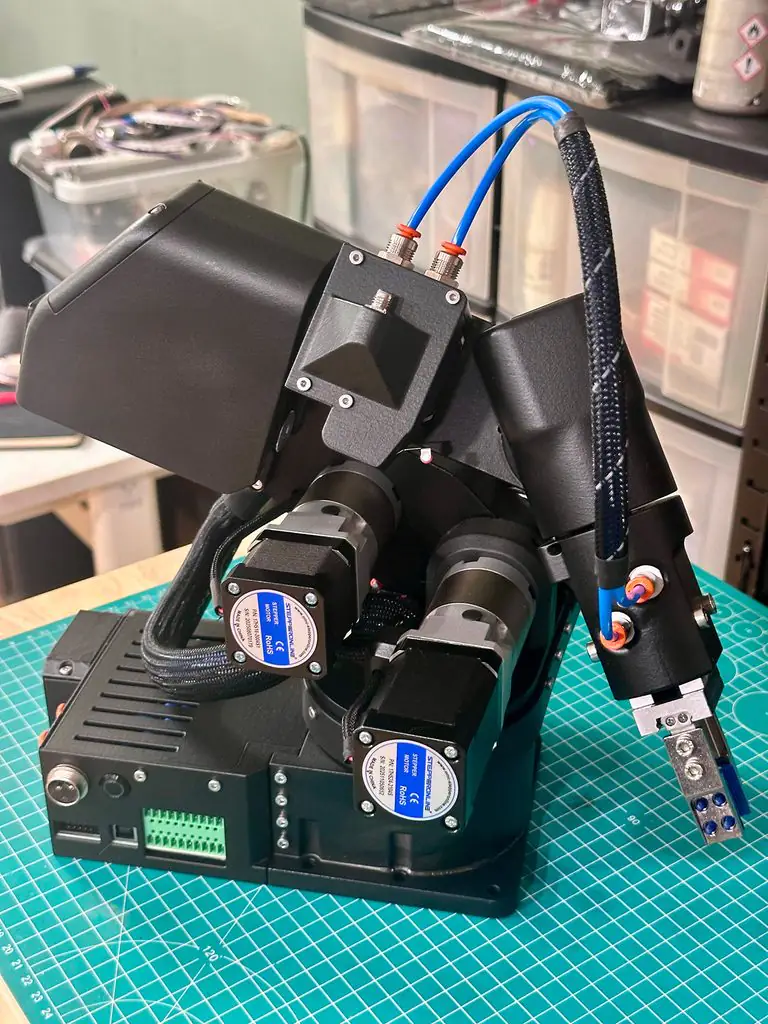
Could Indulite build a collaborative robotic arm and potentially implement it on its own production line for tasks such as pick-and-place operations?
Rather than developing the entire mechanical concept from scratch, Mark started with PAROL6, an open-source robotic arm project.
There was one important challenge: the original design was intended primarily for FDM printing.
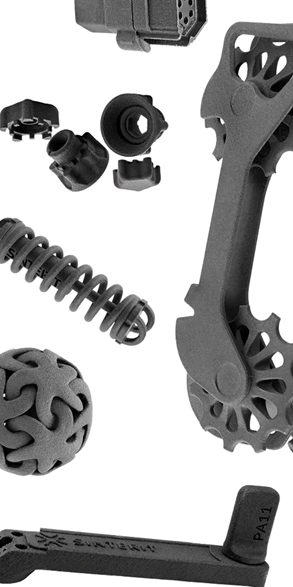
Mark therefore adapted and redesigned selected components specifically for SLS manufacturing before producing them from PA12 Industrial on the Sinterit Lisa X.
This seemingly simple change in manufacturing technology opened up considerably more design freedom.
Why SLS Instead of CNC Machining?
Many of the structural components of a robotic arm could alternatively be manufactured from aluminum using CNC machining.
But for an experimental engineering project, this would introduce a completely different manufacturing workflow.
Each component would have to be machined individually, while complex geometries could require multiple operations – or prove difficult to access with conventional machining tools.
With SLS, Indulite could manufacture geometrically complex polymer parts without tooling and without the same restrictions on tool accessibility.
As Mark explains, producing the parts in aluminum using CNC machining would have taken days, while SLS allowed the team to manufacture them considerably faster and create geometries containing areas that would be difficult or impossible for a CNC tool to reach.
For R&D, that changes the economics of experimentation.
An engineer can modify a component digitally, print another iteration and physically test it – without committing to expensive tooling or machining every new version.
What SLS brought to the project
- Fast production of complex mechanical components
- Freedom from many CNC tool-access limitations
- Easy design modification and iteration
- Production of multiple different geometries within the same SLS workflow
- Functional PA12 components suitable for mechanical applications
The robotic arm therefore becomes more than an impressive printed object. It demonstrates how accessible SLS can become a practical extension of an engineering department.
Where Precision Becomes Critical
Design freedom, however, does not mean that every component can simply be printed and assembled without engineering consideration.
The PAROL6 project contained bearings and other mechanical interfaces where dimensional accuracy was critical.
According to Mark, one of the most challenging aspects of the project was achieving sufficiently accurate dimensions for the bearings to fit correctly. Both the SLS printing process and subsequent vapor smoothing introduce dimensional considerations that need to be accounted for during design. Some parts therefore had to be adjusted and reprinted before the correct fit was achieved.
This became an important part of the development process: designing not only for SLS, but for the complete manufacturing workflow.
For functional assemblies, the final dimensions after post-processing matter just as much as the geometry leaving the printer.
From Printed Part to Professional End-Use Component: The Role of Vapor Smoothing
Printing was only part of the story.
For a robotic system containing moving mechanical components, bearings and lubricants, surface properties also matter. This is where AMT PostPro SFX vapor smoothing became an important part of the workflow.
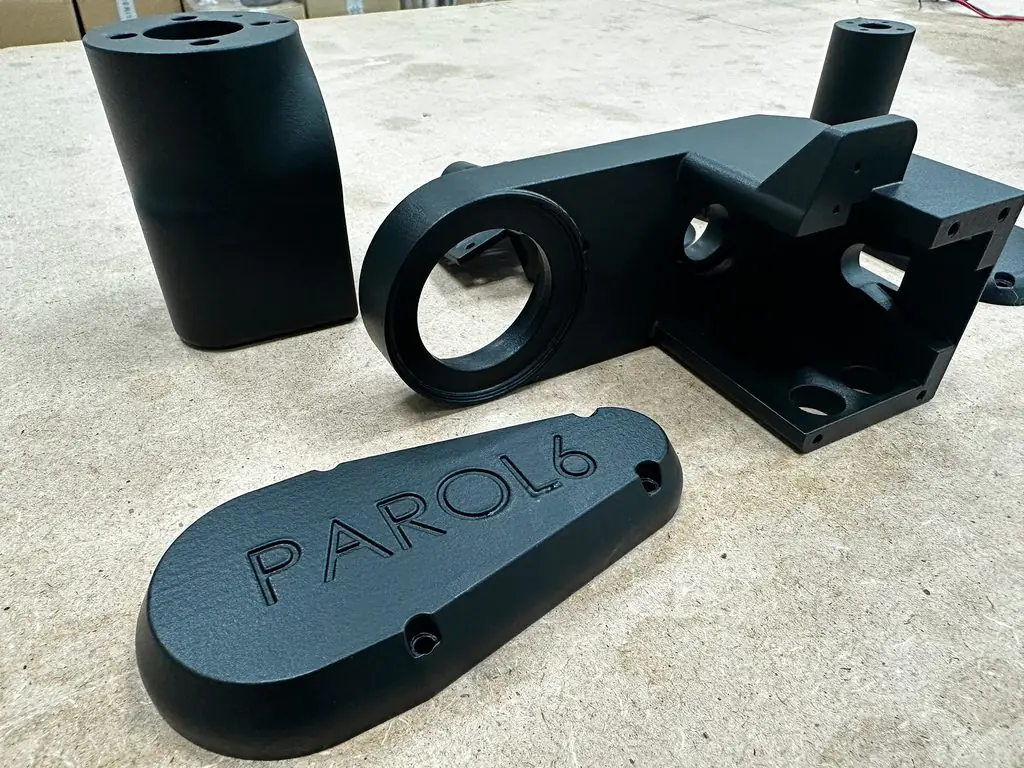
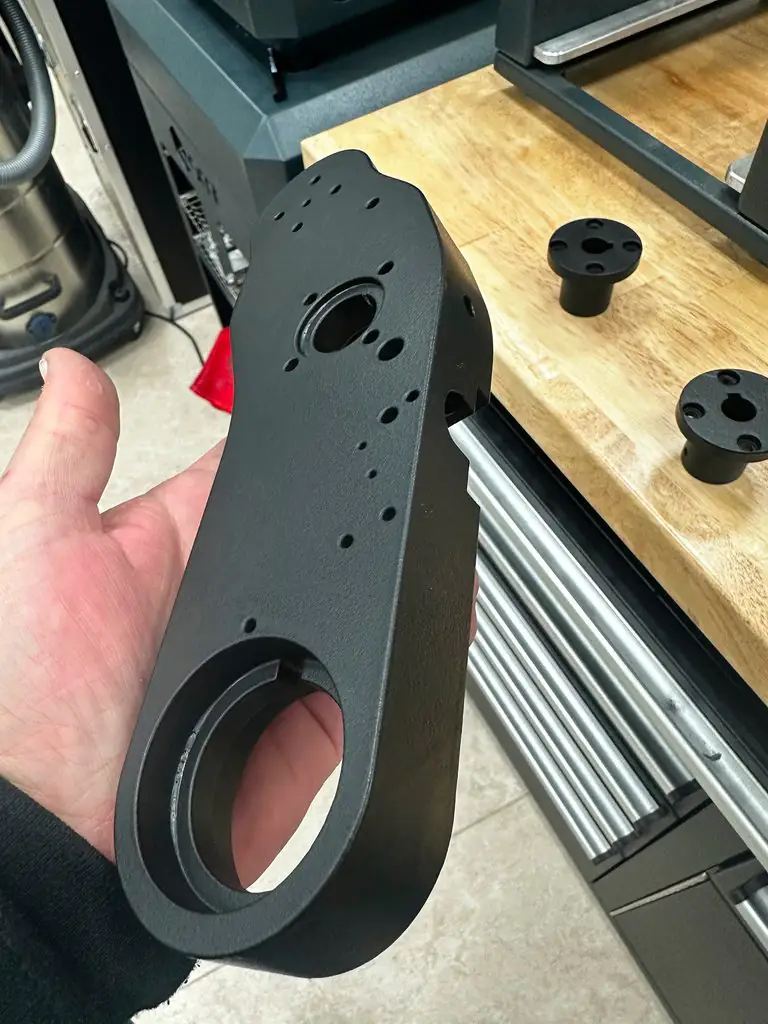
After printing and depowdering, the PA12 Industrial components underwent vapor smoothing to create a much more refined final surface.
The effect was both functional and visual.
According to Mark, vapor smoothing seals the PA12 surface, helping protect it from substances such as grease and oil. At the same time, it transforms the characteristic surface of an SLS print into a smooth, dark, glossy finish and contributes to stronger, more professional end-use parts.
Why vapor smoothing mattered for the robotic arm
Sealed surface
The treatment closes the porous surface characteristic of untreated SLS parts, making the components better suited to an environment where they may come into contact with grease or oil.
Professional appearance
The printed PA12 components gain a smooth, dark and glossy surface. On an assembled robotic arm, this creates a much more consistent, finished-product appearance.
Improved functional properties
Mark also observed increased strength after the vapor smoothing process – an important consideration for components intended for functional mechanical use.
A step toward end-use quality
Perhaps most importantly, post-processing changes how the parts are perceived. They no longer look like development prototypes but like components designed to belong in a finished machine.
For Indulite, that distinction matters.
“It results in having professional end-use parts after the process.” — Mark Riemersma
There is also an important engineering consideration. Because vapor smoothing can influence final dimensions, tolerances need to be considered during the design stage – particularly around precision interfaces such as bearing seats. In this project, achieving the correct fit required several iterations.
A Complete In-House Workflow
The robotic arm was not created with a standalone 3D printer.
It was enabled by the manufacturing ecosystem Indulite has gradually built around SLS.
For this application, the workflow included:
Design adaptation → SLS Printing on Lisa X → Multi PHS → PostPro DPX → PostPro SFX Vapor Smoothing → Assembly
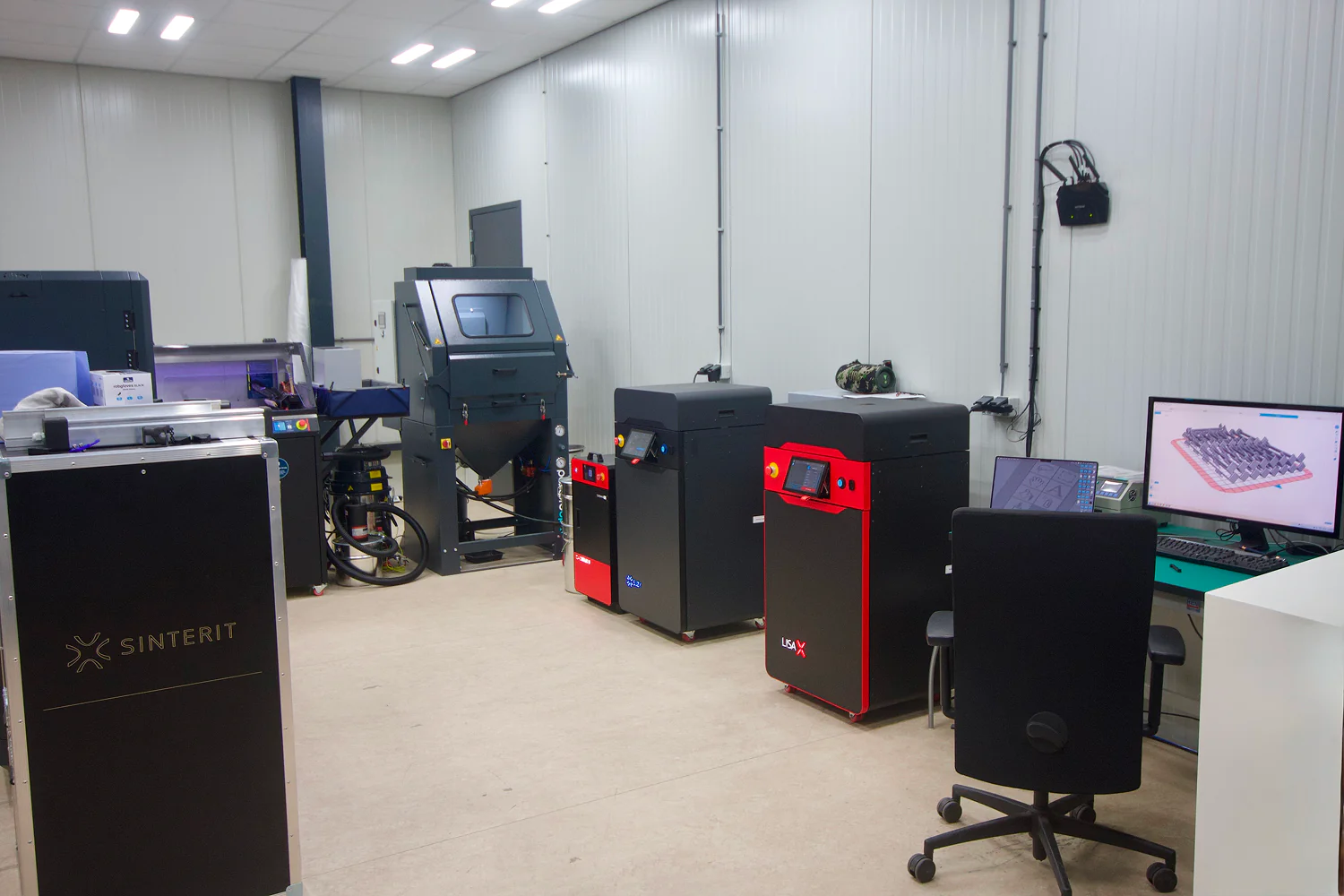
This reflects Indulite’s broader approach to additive manufacturing. The company has implemented an integrated SLS workflow incorporating printing, depowdering, surface cleaning, vapor smoothing and powder preparation rather than treating printing as an isolated process.
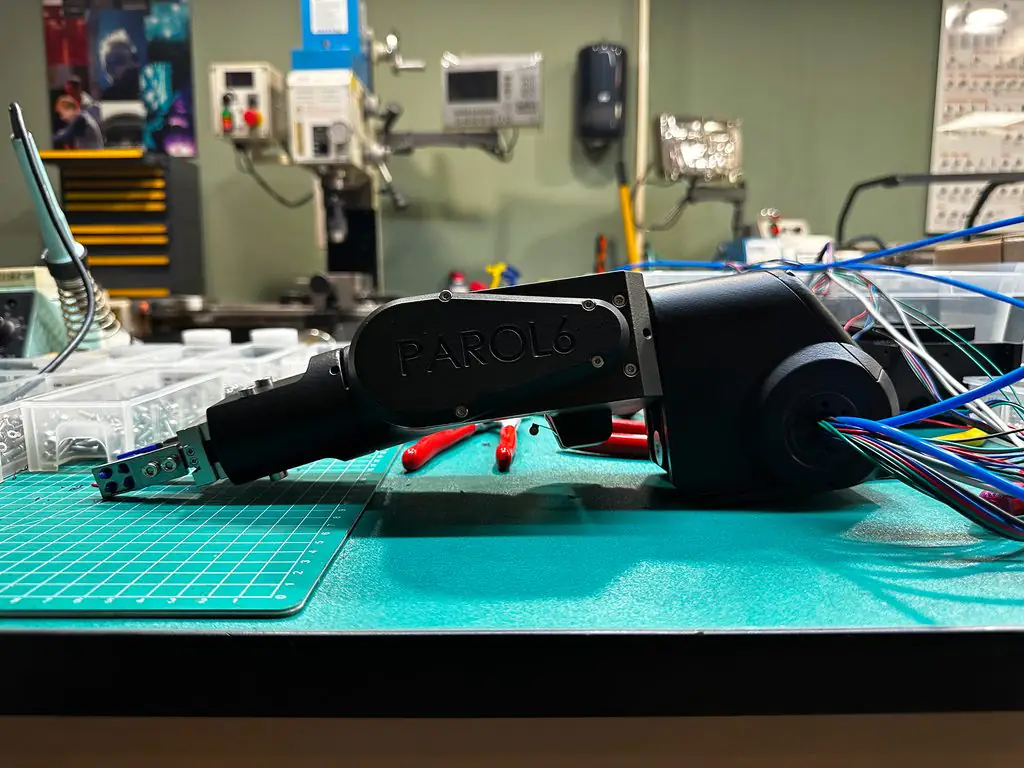
That distinction becomes particularly important when additive manufacturing moves from prototyping toward functional machine components and end-use applications.
It’s always worth making sure that all the right parts are in place before assembly. That’s why Indulite has a dedicated and highly experienced specialist for the job — Bisket the cat 😉
SLS as an R&D Tool, Not Just a Production Technology
Indulite originally adopted SLS to solve very practical manufacturing challenges in its LED lighting business.
FDM did not provide the required mechanical properties and finish for many functional parts. Outsourcing meant long lead times and higher costs. Injection molding was difficult to justify for highly customized or geometrically complex components. Bringing SLS in-house gave the company greater speed, control and flexibility.
The robotic arm demonstrates what can happen next.
Once additive manufacturing becomes part of the company’s everyday engineering infrastructure, its value is no longer limited to replacing components that were previously outsourced.
It becomes a platform for experimentation.
A designer can take an open-source concept, modify it for a different manufacturing technology, produce complex functional components, test mechanical interfaces, refine tolerances, post-process the parts and assemble a working system – all within the company’s own engineering environment.
And that makes projects that might otherwise require significant machining resources much easier to explore.
From Lighting Components to Robotics
There is an interesting progression in Indulite’s use of additive manufacturing.
SLS is already used for approximately 300 parts per month, including end-use components for Indulite’s INDUSTRIA LED product line and functional parts for internal manufacturing equipment.
Now the same manufacturing infrastructure can be used to explore production automation.
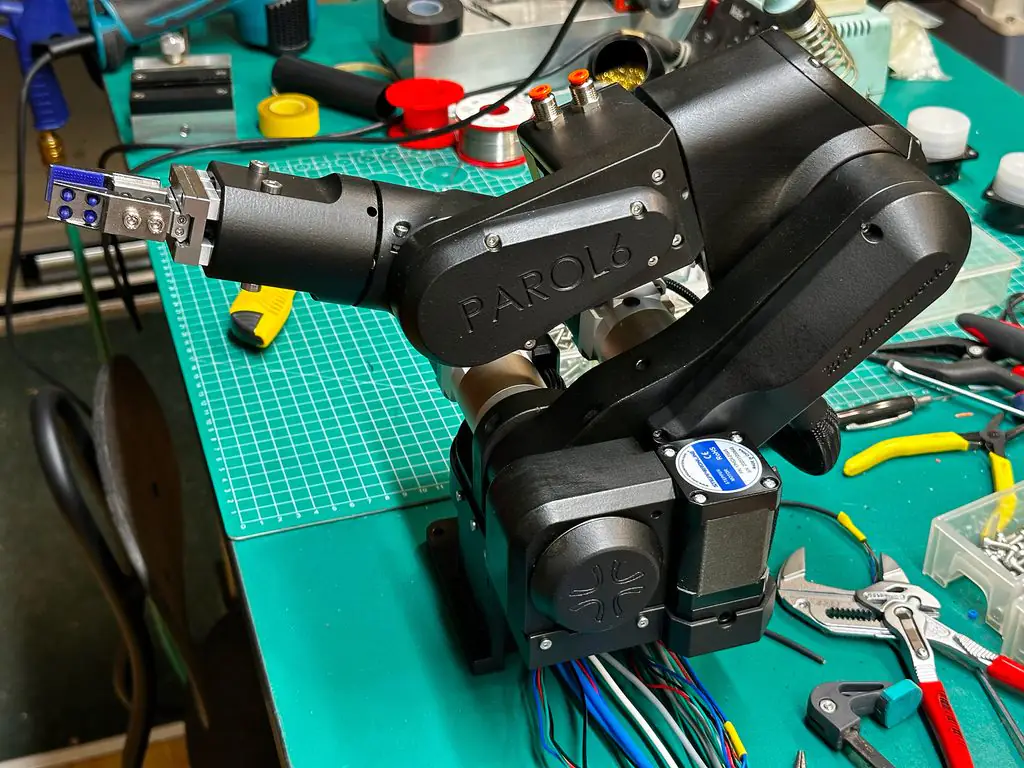
The PAROL6 project was built to investigate whether a robotic arm could eventually support operations such as pick-and-place tasks on Indulite’s production line.
That makes the project particularly interesting.
The SLS printer is not simply manufacturing another product.
It is manufacturing a machine that may eventually help manufacture other products.
When Manufacturing Freedom Creates New Possibilities
The PAROL6 robotic arm is a strong example of what accessible in-house SLS manufacturing can mean for engineering companies.
It allows them to move quickly from:
idea → digital design → functional component → iteration → finished assembly.
Complex geometry can be produced without tooling. Designs can evolve between builds. Functional PA12 components can be manufactured directly in-house. And technologies such as vapor smoothing can take those parts one step further – from recognizable 3D prints to refined components suitable for a professional mechanical assembly.
For Indulite, this is another expression of the engineering philosophy that already defines its approach to manufacturing:
“If you are able to draw it, you can make it.”
The difference is that with an in-house SLS ecosystem, increasingly complex ideas can now be turned into physical, functional systems – including a robotic arm.
And sometimes the most interesting application of a 3D printer isn’t the product it makes.
It’s what that product makes possible.